What Digital Product Passport software should do
Digital Product Passport software should connect product-specific requirements to trustworthy data and evidence, preserve provenance, control who can read or update each field, and support the identifiers, data carriers, registry interactions, and publication rules that apply to the product group. It should not treat a QR-code page as a complete or compliant passport.
The right starting point is evidence readiness. Before choosing a registry connector or printing a data carrier, a team should know:
- which product-group rules are actually in scope;
- which facts and documents are required;
- which internal or supplier system owns each fact;
- whether the evidence is accepted, pending, missing, expired, or disputed;
- how each value was reviewed;
- what can be public and what requires restricted access;
- which implementation decisions remain unknown.
The EU framework is evolving through product-specific measures and standards. The European Commission's Digital Product Passport framework page links the DPP to Regulation (EU) 2024/1781 and relevant standardization work. On 20 July 2026, the Commission announced that the Digital Product Passport Registry and a testing environment were live. That infrastructure milestone does not make every product rule identical or every business automatically ready.
This guide is operational information, not legal advice or a certification of compliance.
DPP software is a stack, not one screen
Organizations may use one platform or several connected tools. The important question is which responsibility each component owns.
Requirement and evidence readiness
This layer maps applicable requirements to facts, documents, tests, declarations, and reviewers. It should show gaps before publication work begins. It is especially useful when evidence arrives from many suppliers in inconsistent formats.
Product master data
PIM, PLM, ERP, quality, and other source systems may own product identity, composition, manufacturing, repair, durability, environmental, or commercial data. A DPP workflow should reference the authoritative source and version rather than create an uncontrolled second truth.
Supplier evidence collection
A supplier portal or structured intake can request the exact evidence needed for a material, component, facility, or product group. It should support due dates, clarification, version replacement, and review—not merely file upload.
Identity and data carrier
Identifiers and carriers connect a physical product or packaging to the correct digital record. Depending on the applicable rule and use case, this may involve standardized identifiers, QR codes, other machine-readable carriers, resolution services, and controls against collisions or incorrect reuse.
Registry integration
A connector may register required identifiers or metadata, validate payloads, handle authentication, and keep evidence of accepted or rejected exchanges. Registry capability should be tested against the current official environment and the exact product rule.
Passport publication and access
The published experience may expose public information while restricting other data to authorized actors. It needs durable URLs or resolution, accessibility, language and lifecycle handling, change control, and appropriate performance.
Governance and assurance
Version history, approvals, provenance, retention, security, and exception handling run across every layer. A beautiful public passport with unreviewed supplier claims remains a data-quality risk.
Start with a requirement map
Do not begin with a generic “DPP fields” spreadsheet copied from a vendor demo. Build a dated map tied to the product group and implementation stage.
For each requirement, record:
- requirement code and plain-language description;
- legal, delegated-act, standard, customer, or internal source;
- product groups and markets in scope;
- effective or review date;
- required data or evidence;
- authoritative owner;
- supplier or internal source;
- permitted values and validation rules;
- public or restricted access class;
- review status and reviewer;
- source version and provenance;
- publication and registry destination, when known.
Represent unknowns explicitly. If a product-specific rule has not been finalized, record that implementation dependency rather than inventing a universal field.
Worked synthetic evidence example
Assume a product group has three configured evidence requirements:
- material origin;
- recycled content;
- carbon declaration.
The supplied records show:
- material-origin evidence accepted from
supplier-14, with a stored content hash; - recycled-content evidence received from the same supplier but still pending review;
- no carbon-declaration evidence attached.
A useful readiness result is:
- Material origin — accepted in this configured review. Preserve the source, reviewer, decision time, document version, and content hash.
- Recycled content — pending. The file exists, but no accepted claim should be published from it yet.
- Carbon declaration — missing. Route a specific request to the responsible supplier or internal owner.
The result is not “DPP compliant.” A hash shows that the reviewed file can be distinguished from a changed file; it does not prove that the document or claim is true. An accepted status reflects the defined review, not approval by a regulator or every downstream customer.
This example also shows why a readiness workflow comes before a public passport. Publishing first would either omit a required fact, expose an unreviewed claim, or hide the gap.
Digital Product Passport software checklist
Scope and rule management
- Can requirements be separated by product group, market, and effective date?
- Can a source and version be attached to every rule?
- Can unknown, not applicable, pending, rejected, and expired remain distinct?
- Can the team update rules without silently rewriting historical decisions?
Data and evidence
- Can every published value point to an authoritative source?
- Can supplier documents be versioned and reviewed?
- Are content hashes or equivalent provenance controls supported?
- Can structured data and documentary evidence coexist?
- Can a reviewer see exactly what changed between versions?
Supplier workflow
- Can requests target the correct supplier, component, and requirement?
- Can the supplier clarify or replace evidence without deleting history?
- Are reminders, escalation, and ownership configurable?
- Can access be limited to the supplier's own records?
- Can the buyer distinguish “file uploaded” from “evidence accepted”?
Validation and quality
- Are units, vocabularies, identifier formats, and mandatory fields validated?
- Can cross-field rules identify contradictions?
- Are duplicate products, components, and documents detected?
- Can a human override be recorded with a reason?
- Does validation fail safely when a rule is unknown?
Security and access
- Can public, restricted, and confidential fields be separated?
- Is tenant and supplier isolation documented and tested?
- Are administrative actions auditable?
- Are retention and deletion rules configurable?
- Does the design minimize unnecessary personal and confidential data?
Integration
- Which PIM, PLM, ERP, quality, commerce, and supplier systems are supported?
- Is data read from an authority or copied into another master?
- How are retries, duplicates, and partial failures handled?
- Can registry submissions be tested without claiming production acceptance?
- Does the system retain request, response, and version evidence without exposing credentials?
Publication and lifecycle
- How is a physical item linked to the correct record?
- What happens when a product, component, supplier, or rule changes?
- Can corrected information be published without losing history?
- What remains available after sale, repair, resale, or end of production?
- Is the published experience accessible and usable on ordinary devices?
Commercial fit
- Is pricing based on products, variants, suppliers, passports, API calls, or users?
- Which implementation and data-cleaning work is excluded?
- Who is responsible for mapping product-specific rules?
- What proof can the vendor provide without relying on fabricated compliance claims?
- Can the team run a bounded readiness assessment before a long contract?
Evidence readiness versus passport generation
A passport generator may create an identifier, QR code, hosted page, or formatted record. Evidence readiness asks whether the underlying information is supported and reviewed.
These are separate gates:
- Scope: identify the applicable product group and rule version.
- Evidence: collect facts and documents from authoritative sources.
- Review: accept, reject, or query each requirement.
- Identity: assign and validate the required identifiers.
- Integration: test registry and source-system exchanges.
- Publication: expose the correct information to the correct audience.
- Lifecycle: update, correct, retain, and retire records under approved rules.
Skipping to step five or six may create an impressive demonstration that cannot survive supplier, quality, or audit questions.
Questions to ask a DPP software provider
Ask the vendor to demonstrate a single requirement from source to publication:
- Where did the requirement come from?
- Which product and rule version does it apply to?
- Who supplied the evidence?
- What was actually reviewed?
- How is the document version identified?
- What happens if the supplier replaces it?
- Which field is published and why?
- Who can see it?
- How is the record changed after correction?
- What does the platform deliberately leave to legal, conformity, or regulatory professionals?
Then ask the vendor to demonstrate failure:
- a missing required document;
- contradictory units;
- an expired declaration;
- an unauthorized supplier;
- a duplicate registry request;
- an unavailable external system;
- a rule whose final implementation is not known.
Safe failure behavior is more revealing than a perfect-path demo.
Common buying mistakes
Buying the QR code first
A carrier is an entry point, not the evidence model. Determine what it must resolve to and how the underlying record is governed.
Treating every product group alike
The framework is implemented through product-specific rules and timelines. Avoid universal templates that blur legal scope.
Calling uploaded evidence verified
Receipt, validation, review, and acceptance are different states. Preserve each transition.
Replacing source systems unintentionally
Decide whether the DPP platform is a master, a workflow layer, a publisher, or a connector for each field.
Believing a completeness percentage proves compliance
A score only reflects the configured map and supplied evidence. It cannot establish that every applicable rule was found or every claim is true.
Honest boundaries
Digital Product Passport software can improve traceability, gap management, data validation, supplier follow-up, and controlled publication. It cannot by itself:
- determine every law or delegated act that applies;
- certify product claims;
- guarantee regulator or registry acceptance;
- prove the truth of supplier evidence;
- replace conformity assessment or qualified legal advice;
- make every product ready on one universal date;
- turn a content hash into third-party verification.
Use current primary Commission materials and product-specific measures when defining scope. Date every requirements page and recheck it as implementation changes.
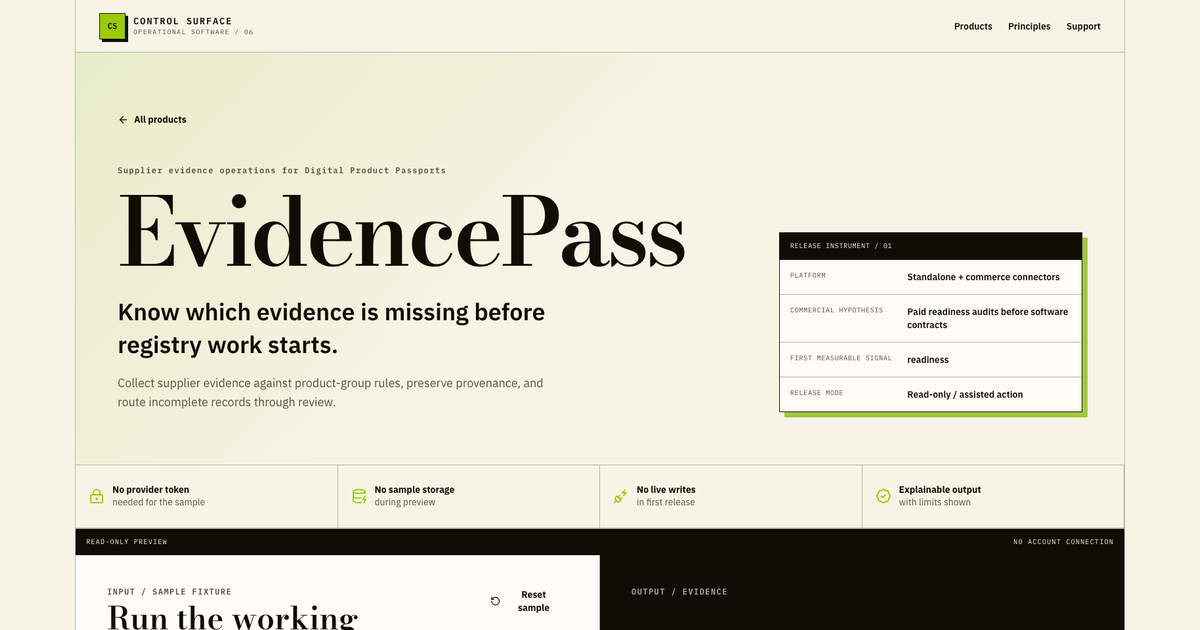
To inspect a synthetic supplier-evidence map before choosing publication infrastructure, run the EvidencePass sample and use the same page to request a paid DPP readiness audit. The audit does not issue an identifier, publish a passport, certify a claim, or guarantee compliance.